%%{init: {"theme": "base", "themeVariables": {"primaryColor": "#E8ECFF", "primaryBorderColor": "#4054B2", "primaryTextColor": "#16171B", "lineColor": "#3B4351", "edgeLabelBackground": "#FAF7F0", "clusterBkg": "#EFE9DC", "clusterBorder": "#766F65"}, "flowchart": {"rankSpacing": 28, "nodeSpacing": 42}}}%%
flowchart TB
  S1["private signal s₁"] -->|"used"| A1(["Agent 1<br/>follows own signal"])
  A1 -->|"choice public"| A2(["Agent 2<br/>follows own signal"])
  S2["s₂"] -->|"used"| A2
  A2 -->|"two aligned choices"| CUT(["private information<br/>stops entering here"])
  CUT --> A3(["Agent 3<br/>rationally copies"])
  S3["s₃"] -.->|"✗ ignored"| A3
  A3 --> A4(["Agents 4 … N<br/>copy"])
  S4["s₄ … sₙ"] -.->|"✗ ignored"| A4
  classDef gate fill:#F7E6B5,stroke:#8A5A00,color:#16171B
  classDef world fill:#EFE9DC,stroke:#766F65,color:#16171B
  class CUT gate
  class S1,S2,S3,S4 world
18 Emergence and Artificial Societies
A starling murmuration has no choreographer. Ten thousand birds wheel and fold as a single fluid body, and not one of them knows the shape it is helping to draw; each attends to its neighbours and its spacing, and the rest is arithmetic nobody performs. The last chapter ended with the designer stepping out of the frame, and this is what the frame looks like afterwards: order that arrives without being ordered. The previous chapter’s closing triple is this chapter’s exhibit list — conventions nobody legislated, segregation nobody intended, markets nobody convened — and its unifying fact is the one the murmuration displays: put enough interacting agents together, and the system acquires behaviour that was specified nowhere, intended by no one, and is nonetheless robust, reproducible, and sometimes breathtaking. The technical name is emergence, and it is the last piece of science this book needs before it can turn, in Part VI, to engineering.
Emergence is the multi-agent field’s oldest dream and its newest worry, and the chapter honours both moods. The dream is the founding one: that societies of simple agents might grow the phenomena the social sciences could only describe — segregation, cooperation, cultural difference, wealth and its distribution — so that a simulation becomes a laboratory and an explanation becomes a working model. The worry is contemporary and arriving on schedule: the deployed world now contains fleets of interacting agents at market scale, and order that nobody intended does not confine itself to being charming. A flash crash is a murmuration too. The engineer therefore reads this chapter in two postures at once — the scientist’s, asking how macro-behaviour follows from micro-rules, and the operator’s, asking which of the resulting phenomena to harvest and which to fence.
The pedigree is long and pleasingly disreputable, in that its founding results keep coming from outside the discipline. Economists supplied the first and greatest exhibit — the price system, whose undesigned coordination Chapter 15 admired and whose lesson this chapter was promised: the most consequential piece of multi-agent engineering in history was not engineered. Physics contributed the licence to take all this seriously: Anderson’s More Is Different made the case that aggregate behaviour obeys principles that cannot be read off the components, in any science. Schelling showed with coins on a grid that mild individual preferences can produce total collective segregation — the canonical demonstration that macro-outcomes need not resemble micro-intentions. Computer science added the working toys that became instruments: cellular automata, Reynolds’s three-rule flocks, Epstein and Axtell’s Sugarscape societies. And the language-model era added the newest instrument in the case: generative-agent towns whose inhabitants remember, plan, gossip — and coordinate parties nobody scheduled.
One announcement and one stipulation, before the roadmap. The announcement: this chapter’s examples cannot honestly come from the book’s running software-engineering team, because four agents are a team, not a society — emergence is a large-numbers phenomenon, and pretending otherwise would be exactly the theatrical overclaiming this chapter exists to caution against. So the satellite scenario the preface licensed arrives on duty: a simulated society, used where the spine cannot reach. The stipulation: the preface promised methodological cautions with the more theatrical demonstrations, and they will be delivered at full strength — this is the chapter where the book’s enthusiasm and its scepticism must both be on stage. We proceed from what emergence is and is not (Section 18.1); through three parables every multi-agent engineer should be able to tell at a whiteboard — segregation, flocks, and cascades (Section 18.2); to the method that grew from them, agent-based modelling and its generative credo (Section 18.3); to the silicon societies of the present moment and the validity questions they raise (Section 18.4); and finally to emergence in production — the deployed fleet as an artificial society, and what that means for the engineering to come (Section 18.5), where Part V hands over to Part VI.
18.1 More Is Different: What Emergence Is
Begin with the mark that separates emergence from mere collective action. When a protocol makes four agents produce a release together, the release is collective but not emergent: some rule, somewhere, says produce the release. Emergence is the other case — system-level behaviour that no rule mentions, that no agent intends, and that often cannot even be described in the agents’ own vocabulary. No starling’s rules contain the word flock. No driver’s habits contain the phrase traffic jam — and the jam is the sharper example, because it is unmistakably a thing, with a position, a lifespan, and a velocity of its own, and its velocity points backwards: the jam crawls upstream while every car inside it moves forward. An object nobody made, moving in a direction nobody moves, described in words that apply to no participant. The reader has, in fact, been meeting such objects all book without the label: Chapter 11’s deadlock was an object of exactly this kind — two courteous rules and no mention of deadlock anywhere — and Chapter 17’s collusion was another, an institution present in no agent’s instructions. This chapter finally names the genus.
The licence to treat such things as real — and not as loose talk to be tidied up later — came, appropriately, from physics. Anderson’s More Is Different took aim at what he called the constructionist hypothesis, and his sentence has organised the discussion ever since: “The ability to reduce everything to simple fundamental laws does not imply the ability to start from those laws and reconstruct the universe” (1972). Reduction runs downhill; construction does not run back up. At each level of aggregation, he argued, genuinely new properties and new laws appear, requiring their own science: psychology is not applied biology, and biology is not applied chemistry. And this book opened with precisely that argument, one level up — a multi-agent system is not applied single-agent AI, and the failures of Chapter 1 were failures visible only at the level of the collective. Chapter 1’s thesis, it turns out, had a Nobel laureate’s licence all along.
A deflation is owed before the concept does any work, because emergence attracts mysticism the way ledgers attract errors. Philosophers distinguish strong emergence — macro-properties irreducible in principle, exerting spooky downward causation — from weak emergence, in which the macro-behaviour follows entirely from the micro-rules but by no shorter route than running them: derivable, yet only by simulation. Everything in this chapter, and everything the engineer will ever need, is the weak kind, and its operational content is a single humbling fact: for weakly emergent phenomena, the cheapest way to discover what the system does is to run the system. There is no closed form for the flock, no static analysis that finds the traffic jam; prediction and simulation collapse into the same activity. That one fact explains why agent-based modelling exists as a method (Section 18.3), and it should ring an engineering alarm the reader will hear again in Chapter 24: a system whose collective behaviour is weakly emergent cannot be fully certified by inspecting its parts. The whole must be exercised, because the whole is where the behaviour lives.
What one does about emergence depends on which of two postures one occupies, and the chapter will keep both in play. The scientist’s question is explanatory: given the macro-pattern — segregation, cooperation, a price level — what micro-rules suffice to produce it? The engineer’s question is operational, and it forks: emergence to harvest, or emergence to fence? Harvesting is not hypothetical — this book has been doing it for seven chapters. Chapter 11’s stigmergy put emergence on the payroll: no ant carries a route table, and the colony has one. Its conventions, once seeded, sustain themselves. Chapter 15’s markets are harvested emergence at civilisation scale — prices nobody sets doing coordination nobody manages. In every harvested case, note, the emergence is bounded by an institution: the pheromone field has its evaporation rate, the market its rules of exchange. The fencing case — deadlock, herding, collusion, the cascade — is the same phenomenon with the sign flipped, and it gets the chapter’s final section.
Which brings the chapter to the debt it was born owing. Chapter 15 admired the price system as machinery and left a note: the marvel was not designed at all, and Part V would say what to make of that. Here is what to make of it. The most consequential coordination device in human history — the mechanism Hayek judged worthy of acclaim as one of the mind’s great inventions, had anyone invented it — emerged: from millions of local exchanges, no designer anywhere, the way the jam emerges from traffic (1945). That is the deepest reason this chapter belongs in an engineering book: the ceiling on what undesigned order can achieve is demonstrably very high. But the same file contains the flash crash, and the pairing is the lesson in full. Emergence produced the marvel and the meltdown by the same means; undesigned means neither benign nor malign, only unowned — spontaneous order has no warranty department. Reasoning about when it will be the marvel and when the meltdown starts small, with three models simple enough to hold in the head and famous enough to argue with. They are the next section’s parables.
18.2 Three Parables: Segregation, Flocks, and Cascades
The study of emergence advances by parable: models small enough to fit on a napkin, whose behaviour nonetheless surprises the person who drew them. This section presents the three every multi-agent engineer should carry as standard equipment, chosen because they span the territory — one about space (how sorting happens), one about motion (how coordination happens), one about information (how belief happens) — and because each teaches a lesson that recurs, at production scale, in systems the reader will actually run. None requires an equation to state, all three reward simulation to believe, and each has spent decades resisting every attempt to explain it away.
| Parable | Micro-rule → macro-outcome | The lesson | Recurs in production |
|---|---|---|---|
| Schelling’s segregation model (1971) | Stay unless a third of neighbours are one’s own kind → stark segregation past anyone’s preference | The outcome carries no signature of intent; tipping points hide in gentle parameters | Mild routing preferences sort a fleet into self-reinforcing clusters |
| Reynolds’s boids (1987) | Separation, alignment, cohesion, each watching only nearby flockmates → a coherent, leaderless flock | Collective complexity needs neither complex individuals nor central control | Chapter 11’s swarm coordination; Section 17.3’s trained graph-network teams |
| Information cascade (Bikhchandani et al., 1992) | Rational agents choose in sequence, seeing choices but not signals → confident, fragile unanimity | Independence dies; collect judgements independently before revealing any | A pipeline reading predecessors’ verdicts — the rubber-stamping reviewer |
18.2.1 The Coins That Moved House
Schelling’s segregation model was famously first run with coins on a squared grid, no computer involved (1971). Two kinds of agent occupy cells; each is mildly particular about its neighbours — content to stay unless, say, fewer than a third of the adjacent cells hold its own kind, which is to say every agent is perfectly happy as a local minority; discontented agents move to the nearest satisfying vacancy. Run it, and mixed neighbourhoods dissolve: chains of small, individually reasonable relocations tip one another off, and the board settles into stark segregation — a macro-outcome dramatically more extreme than any single agent’s preference demanded, produced by a population that would have been content with far less.
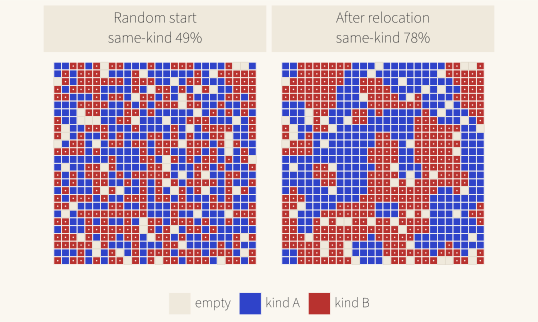
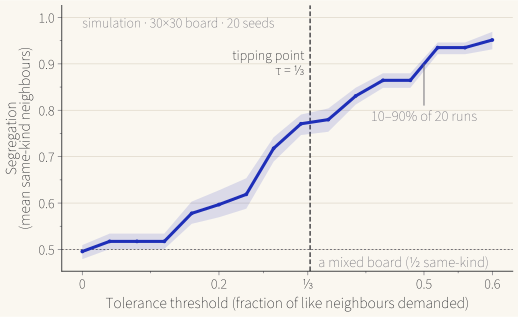
The parable’s lesson is an inference ban, and it cuts in both directions. Observing the segregated board, one cannot conclude that anyone wanted segregation — the outcome carries no signature of the intentions that produced it; and knowing the mild intentions, one could never have guessed the stark outcome without running the board. For the fleet operator the ban translates directly: reading a system’s collective behaviour as evidence of its members’ dispositions — “the agents have all crowded onto one queue, they must strongly prefer it” — is a fallacy with a fifty-year-old counterexample, and mild preferences in a routing or assignment policy can sort a fleet into stark, self-reinforcing clusters that no threshold in any config file appears to demand. Schelling’s other gift is the tipping point: macro-behaviour that responds smoothly to a parameter until, at some unremarkable value, it does not — the reason parameter sweeps, not spot checks, are the honest way to know what a collective will do, and the reason his book-length treatment bore the title that named this whole subject: micromotives and macrobehaviour (1978).
18.2.2 Three Rules and a Flock
The murmuration that opened this chapter was explained — to the satisfaction of both ornithology and cinema — by a graphics researcher wanting believable animation. Reynolds’s boids steer by three local rules: separation (don’t crowd your neighbours), alignment (match their heading), cohesion (drift toward their centre) — each bird attending only to its nearby flockmates, no leader, no plan, no global view anywhere (1987). The result flocks: it streams around obstacles, splits and re-merges, and produces the great folding sheets of the real phenomenon, well enough that the technique went more or less straight into film production. Three sentences of behaviour; a sky full of consequence.
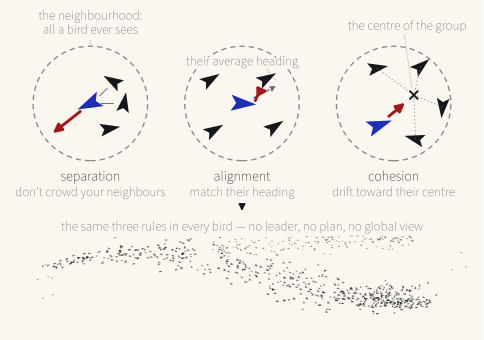
The lesson is Gode and Sunder’s, one level up: complex collective behaviour requires neither complex individuals nor central control, because the choreography lives in the interaction pattern, not in any dancer. For the engineer this makes local rules a design surface — the global behaviour is programmed, indirectly, by choosing what each agent attends to and how it responds — with the crucial caveat Section 18.1 flagged: the mapping from rule to consequence runs through simulation, not intuition, and the way to learn it is ablation — delete one rule and observe which macro-property dies with it. The exercise is instructive precisely because the answers are not guessable. And the lineage runs forward through this book: Chapter 11‘s swarm coordination is boids’ engineered cousin, and Section 17.3’s graph-network teams are its trained descendants — local attention, learned instead of written, flocking on real hardware.
18.2.3 The Confident Queue
The third parable moves from space and motion to belief, and it is the one with teeth. Bikhchandani, Hirshleifer, and Welch modelled agents choosing in sequence — each holding one noisy private signal, each observing the choices (not the signals) of those before it, each perfectly rational (1992). The arithmetic is brutal and quick: once the first few choices lean the same way, the public evidence outweighs any single private signal, so the rational move for every subsequent agent is to ignore its own information and follow — an information cascade, in which unanimity forms, hardens, and propagates indefinitely on the strength of, perhaps, two early draws. The queue looks overwhelmingly informed. It contains almost no information: a thousand identical choices carrying the evidential weight of the first two.
Every clause of that construction should sound familiar, because the reader has met the phenomenon twice from other directions — as Chapter 13‘s independence condition dying (the jurors here do not merely correlate; they rationally discard their own evidence), and as the herding that Section 14.6’s debate audit priced. What the parable adds is the flip side: cascades are fragile — built on almost nothing, they can be shattered by almost nothing, one contrarian with visibly better information collapsing a thousand-agent consensus overnight, which is why fads end as abruptly as they begin. The production translation is uncomfortably direct: a pipeline in which each agent sees its predecessors’ verdicts before forming its own is a cascade machine — the fourth reviewer who reads three approvals and rubber-stamps is not lazy but rational, and precisely thereby useless. The remedy the book has now derived three separate times — from juries, from debates, and here from first principles — deserves its standing as a design law: collect judgements independently before revealing anyone’s to anyone. With the parables in hand, the natural next question is what happens when they stop being parables and become a method.
18.3 Growing Societies: Agent-Based Models
Turn the exhibits into an instrument and you have agent-based modelling: populate a world with explicit agents, give each its rules, run the whole, and study what grows. The method comes with a manifesto — generative social science — and the manifesto has a credo, Epstein’s: “if you didn’t grow it, you didn’t explain its emergence” (1999). The demand is bracing when set against the social sciences’ usual standards of explanation. It is not enough to correlate segregation with preferences or fit a curve to a wealth distribution; a generative explanation must exhibit a population of plausible agents whose interactions actually produce the phenomenon, in the running model, from the bottom up. An equation describes; a grown society demonstrates. The method is, in other words, this book’s constituency doing social science: explanation by construction, with the simulation standing where the proof would be.
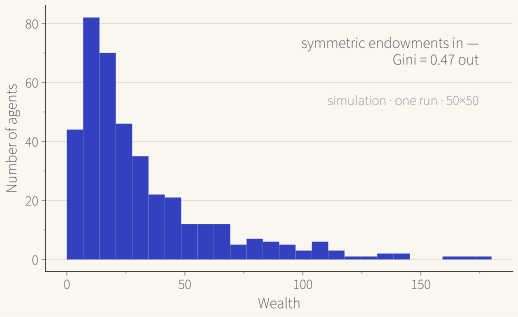
The demonstration estate is Sugarscape, and its yield remains startling to walk through (Epstein & Axtell, 1996). Epstein and Axtell laid out a grid bearing sugar, and agents bearing a metabolism, a range of vision, and a rule — move to the richest visible unoccupied cell, eat, repeat. From this austerity grew a curriculum: migration waves, seasonal rhythms, carrying capacities; add a second commodity and trade appears, with prices; add rules for reproduction, combat, and cultural tags, and there are wars, tribes, and epidemics. The most quoted result is the distribution of wealth: endow agents with modest, symmetrically distributed differences in vision and metabolism, and the society that grows is starkly unequal — a right-skewed distribution with a long rich tail, produced without a greedy agent anywhere in the model, because small advantages compound positionally: the sharp-eyed reach the good cells first, and the good cells fund the next move. Nobody hoarded; the distribution emerged. It is Schelling’s inference ban writ economic — the macro-pattern carries no signature of individual vice — and it made the book’s subtitle a slogan for a generation: social science from the bottom up.
Two further growths matter to this book because they grow institutions — the very things Part IV built by hand. Axelrod’s culture model has agents imitate the attributes of similar neighbours — homophily plus influence, nothing else — and produces a result with a paradox in its title: local convergence, global polarisation (1997). Neighbourhoods homogenise, and their very homogenising crystallises the map into distinct, stable cultural regions that no longer interact: imitation, of all things, manufacturing durable difference. And the naming game grows Chapter 11’s conventions without Chapter 11’s designer: agents in random pairs propose and adopt words for things, remembering successes, and the population undergoes a sharp transition from babel to a single shared vocabulary — a convention with no committee, no legislator, and no announcement (Baronchelli et al., 2006). Chapter 11 gave conventions their first route (design them offline and distribute); this is the second (let the population find them); and Section 17.4’s emergent communication was the same phenomenon a third way, learned by gradient inside a training loop. Three routes, one institution — and only the first leaves documentation.
The method’s honesty clause must now be read aloud, because growing is easier than it looks and proves less than it feels. Generative sufficiency is a candidate explanation, not a confirmed one: the credo says grown-or-no-explanation, and says nothing about grown-therefore-true. The standing trouble is equifinality — many different micro-stories grow the same macro-pattern, so exhibiting one mechanism does not privilege it over its unexhibited rivals — and its everyday accomplice is thin calibration: a model tuned to reproduce one summary statistic has been fitted, not tested. The discipline that answers both is unglamorous: target multiple macro-patterns at once, hold some out, sweep the parameters rather than spot-check them (Schelling’s tipping points make single runs actively misleading), and — the exercise this chapter sets — try to grow the same macro from a different micro-story, because succeeding is the strongest possible warning about what the first success proved. The maxim the reader should carry into the next section, where it will be needed at higher stakes: an animation is not an argument.
Why this decades-old method now deserves a fresh look is a matter of what changed. For most of its life ABM was the poor relation of the modelling sciences — computationally quaint, hard to calibrate, its agents so simple that critics could ask what, exactly, the simulations were simulations of. Both complaints have aged badly. The computation is now trivial. And the agents have become interesting: the micro-rules of a model can now be a language model with a memory, a personality sketch, and a diary — micro-realism the field’s founders could not have budgeted for. What has not changed is a single line of the honesty clause; it has merely acquired a new difficulty, because when the micro-rules were three sentences one could at least read them, and when the micro-rules are a foundation model one cannot. Societies grown from such agents are the next section’s subject, and they arrive carrying both halves of this section at once: the generative dream, fulfilled beyond its founders’ ambitions, and the validation problem, squared.
18.4 Silicon Societies: Generative Agents and LLM Populations
In 2023 a pixel-art town called Smallville acquired twenty-five residents, and the residents acquired lives. Park and colleagues gave each generative agent an architecture the reader of Part II will recognise on sight — an observation loop, a planner, a reflection step, and the scored memory stream whose recall formula Chapter 7 borrowed — then set them loose to keep shop, teach, paint, and talk (2023). What happened next was not in anybody’s script. News of one resident’s mayoral candidacy spread through the town by word of mouth; relationships formed and were remembered, agents referencing past conversations in later ones; and, most famously, a single agent seeded with the intention to host a Valentine’s party set off a cascade of invitations, decorations, date-making, and attendance — a coordinated social event that emerged from the population, plans and all. It was Section 18.3’s method with the micro-rules promoted from three sentences to entire agents, and the honest reaction is the one the field had: wonder first, questions immediately after.
Grant the wonder its due before the questions, because the instrument is genuinely new in two ways. First, micro-realism: classical agent-based models could never reach the phenomena that live in talk — gossip, reputation, apology, persuasion, the small institutions of Chapter 16 in embryo — because their agents had no language to conduct them in; generative agents do, which opens the social phenomena that are made of conversation to the growing method for the first time. Second, the survey instrument: Argyle and colleagues showed that a language model conditioned on real sociodemographic backstories reproduces the response distributions of the corresponding human subgroups with unsettling fidelity — silicon sampling (2023) — which offers the social sciences pilot studies without fieldwork and this book’s readers something more pointed: a population on which to rehearse a mechanism. The Chapter 15 designer who would like to know how an auction fares against a thousand strategic participants before any human money is staked now has somewhere to ask.
The result that best joins this chapter’s threads, though, is the one that re-ran Section 18.3’s naming game with the new agents. Ashery, Aiello, and Baronchelli set populations of language models playing it — pairwise interactions, local memory, no central coordination — and found the classical dynamics intact: conventions crystallise spontaneously, babel to shared vocabulary, exactly as the theory and the human experiments had it (2025). Then came the two findings with edges. The populations developed collective biases — systematic preferences among conventions — that the individual agents demonstrably did not hold: a macro-property with no micro-counterpart, which is Section 18.1’s definition of emergence passing an empirical test in silicon. And small committed minorities of agents could tip the whole population from one established convention to another — Schelling’s tipping, operating in belief space. The practical moral is aimed squarely at this book’s audience: auditing agents one at a time cannot certify the population, because some of the population’s properties are not in any agent. The fleet must be audited as a fleet.
Now the cautions, which the preface ordered in advance and this section is contractually obliged to deliver. The first is about what a role-played society is. A language model animating twenty-five townsfolk is drawing on its training distribution — fiction, forums, textbooks, the accumulated written record of how people are said to behave — so what a generative-agent simulation reproduces, first and foremost, is the corpus’s theory of society, rendered with great fluency. That the town’s gossip spreads the way gossip spreads in novels is a finding about novels, and only maybe about gossip. The second caution is Clever Hans, socialised: what the prompt implies, the demonstration tends to deliver — a resident seeded with party-hosting intentions in a town built for social simulation is not a neutral test of whether parties emerge. Neither caution is a dismissal; both convert directly into method: paraphrase the prompts and see what survives; vary the seeds; swap the underlying model, because a social phenomenon that dies under a model swap was a property of one checkpoint, not of society.
What remains is to say precisely what a theatrical demonstration establishes, because the demo-to-headline pipeline reliably says more. Smallville is an existence proof, and a real one: the machinery of memory, reflection, and planning can sustain a legible multi-day social fabric — that is a genuine architectural result, and Chapter 7 has already spent it. What no demonstration of this kind establishes is that the grown dynamics track human social dynamics, or that the frequencies in the simulation estimate any frequency in the world; those claims need Section 18.3’s discipline — multiple targets, holdouts, sweeps, rival micro-stories — applied doubly, because the micro-rules are now unreadable. An animation is not an argument, and these animations can talk, which makes them more persuasive and no more probative.
Read with the discipline, silicon societies are a genuine new laboratory — counterfactuals for pennies, interventions that would be impossible or unconscionable on humans, mechanisms rehearsed before deployment. And the laboratory framing itself carries the section’s last, sobering thought: the largest LLM societies in existence are not in laboratories. They are in production — fleets, markets, feeds — running the same dynamics with real stakes, and they are the final section’s business.
18.5 Emergence on Duty: The Fleet as a Society
Strip away the pixel art and the laboratory framing, and every property this chapter has described is already running in production. An electronic market is a population of interacting automated agents; so is an advertising exchange, a recommender ecosystem, a swarm of trading bots, and — increasingly — a deployed fleet of language-model agents sharing tools, queues, and a budget. These populations have local rules, dense interaction, and scale, which is the entire recipe; the macro-behaviour is therefore not optional, and the only open question is whether anyone is instrumented to see it. This closing section makes the case that emergence is a reliability topic — that the operator of any sizeable agent system is, whether or not the job description says so, the warden of a small artificial society.
The canonical demonstration cost real money. On the afternoon of 6 May 2010, United States markets went into freefall without a cause: in minutes, major indices dropped nearly a tenth, close to a trillion dollars of market value evaporated, blue-chip shares traded momentarily at a cent — and then most of it came back, inside the half hour. The forensic reconstruction found no villain and no bug (Kirilenko et al., 2017): a large, entirely legitimate automated sell program met a crowd of high-frequency intermediaries who bought, could not hold, and passed the inventory among themselves — the notorious hot potato — each algorithm doing exactly what it was designed to do, faster and faster, while the market’s capacity to absorb the volume silently emptied. The Flash Crash was not in any system. It was a property of the ensemble — the market’s murmuration, folding the wrong way — and the institutional response is instructive because it is this book’s vocabulary in regulatory dress: circuit breakers, mandatory trading halts that trip on collective metrics. Chapter 16 called the pattern regimentation; here it is regimentation applied not to an agent but to a population.
For fleets of language-model agents, one structural fact makes all of this chapter’s phenomena easier to trigger and worse when triggered, and three chapters have prepared the point. Chapter 13’s photocopied jurors, Chapter 15’s naturally colluding copies, and Section 18.4’s collective bias all circle the same point: a fleet of instances of one model is a population with almost perfectly correlated dispositions. Human societies get diversity free and must engineer uniformity; agent fleets get uniformity free and must engineer diversity — emergence’s preconditions arrive inverted, so that cascades, herding, and synchronised failure are the path of least resistance while wisdom-of-crowds effects are the achievement. The consequences are concrete: a prompt regression is not one agent’s bad day but a simultaneous behavioural shift across the entire population — monoculture failure, the agricultural analogy exact, one pathogen and the whole harvest — and Chapter 17’s pricing agents stand as the reminder that when the correlated population also adapts, it can converge on collective strategies, collusion included, that no instance was given (Calvano et al., 2020).
The operator’s kit, then, comes in the two halves Section 18.1 promised (Table 18.2, Table 18.3), and the harvesting half has a discipline. Farmed emergence is everywhere in this book — stigmergy carrying coordination through the environment, markets aggregating dispersed information, conventions hardening into cheap coordination — and every successful case shares one feature: the emergence is bounded by an institution built first. The pheromone field has its evaporation rate; the market has its rules of exchange and its budget caps; the convention has its fallback when it fails to form. The discipline, stated once for the whole book: never deploy the phenomenon without its fence — decide, before the emergence is switched on, what will damp it, what will cap it, and what will halt it, because Section 18.2’s tipping points guarantee that the parameter regime you tested is not the only one you will visit.
| Instrument | What it does | Collective handle | Where built |
|---|---|---|---|
| Stigmergy | Carrying coordination through the environment | An evaporation rate | Chapter 11 |
| Markets | Aggregating dispersed information into prices | Rules of exchange and budget caps | Chapter 15 |
| Conventions | Hardening into cheap, self-sustaining coordination | A fallback for when they fail to form | Chapter 11 |
The fencing half (Table 18.3) is the same thinking run defensively, and its entries name their own chapters. Circuit breakers: halt rules tripping on collective metrics — aggregate spend rates, cross-agent agreement spikes, queue synchrony — because per-agent thresholds cannot see a stampede in which every animal is individually within limits. Engineered diversity: mixed models, staggered updates, heterogeneous prompts and contexts — Chapter 13’s jury condition and Section 17.4’s league lesson, promoted to fleet procurement policy. Collective observability: dashboards that carry population-level statistics — a clustering index, a convergence measure, an inequality coefficient — alongside per-agent health, because Section 18.1 established that the behaviour lives at the level nobody is watching; Chapter 24 turns this into method. And blast-radius containment — compartments, quotas, kill-switches scoped to sub-populations — which is Chapter 23 and Chapter 25’s business, foreshadowed here with one sentence of justification: in a correlated fleet, the default blast radius is everything.
| Instrument | What it does | Collective handle | Where built |
|---|---|---|---|
| Circuit breakers | Halting the population on collective metrics | Aggregate spend rates, agreement spikes, queue synchrony | Chapter 16 |
| Engineered diversity | Breaking the fleet’s correlated disposition | Mixed models, staggered updates, heterogeneous prompts | Chapter 13, Section 17.4 |
| Collective observability | Watching the level nobody is watching | Clustering index, convergence measure, inequality coefficient | Chapter 24 |
| Blast-radius containment | Capping the reach of a shared flaw | Compartments, quotas, sub-population kill-switches | Chapter 23, Chapter 25 |
And with that, Part V can be closed and accounted for. Chapter 17 withdrew the assumption that agents stay fixed: they learn, at three timescales, and every institution they touch becomes a curriculum. This chapter withdrew the assumption that behaviour is authored: put enough interacting agents together — learning or not — and the system acquires conduct of its own, from conventions to crashes. Together they are the science of the unprogrammed: the two ways a deployed multi-agent system will, with certainty, exceed its specification. Parts I through IV built by design — agents, conversations, teams, institutions — and Part V’s parting claim is that the designed system is never the whole system: it learns, and it emerges, and the engineer who plans for neither is planning a surprise.
What follows is the turn the whole book has been building toward. The science is now on the table: what agents are, how they talk, cooperate, compete, decide, learn, and exceed their briefs. Part VI picks up the pen — frameworks and what they actually provide, a team built from scratch with no framework at all, the architectural patterns that recur, the protocols that let strangers’ agents interoperate — engineering, conducted with everything the first five parts established in view. Part V explained what nobody wrote. Part VI writes.
18.6 Summary
- Emergence is macro-behaviour specified nowhere in the micro-rules. More is different: aggregates obey regularities that cannot be read off the components, and the engineer’s working notion is deflationary — no mysticism required, only the persistent gap between what agents are told and what populations do.
- The classic parables earn their keep at the whiteboard. Schelling’s grid shows mild individual preferences producing total segregation — macro-outcomes need not resemble micro-intentions, and tipping points hide in gentle parameters. Reynolds’s three rules grow a flock with no leader and no plan. Information cascades show rational imitation producing unanimity that is confident, contagious, and wrong.
- Agent-based modelling turned the parables into a method. Grow the phenomenon from explicit micro-rules and you have a candidate explanation — but grown is necessary, not sufficient: many different micro-stories grow the same macro-pattern, and a model calibrated to one summary statistic has explained less than its animation suggests.
- Conventions emerge as well as being designed. Chapter 11 legislated them; populations also grow them — naming games converge on shared vocabularies nobody proposed, in humans and in language-model populations alike, complete with collective biases that no individual member holds.
- Generative-agent societies are the new instrument, and the cautions are load-bearing. Memory, planning, and reflection per agent yield genuinely emergent social texture — information diffuses, relationships form, parties get coordinated — but a model role-playing a society reproduces its training data’s theory of society, so validity must be earned per phenomenon, not inferred from charm.
- Deployed fleets are already artificial societies. Flash crashes, herding, and learned collusion are emergence in production; correlated behaviour across copies of one model gives the phenomena unprecedented reach; and the subject belongs to reliability engineering, not to the curiosity shelf.
- Emergence is something to harvest and something to fence. Stigmergy, markets, and conventions are emergence deliberately farmed, with institutions to bound them; circuit breakers, fleet diversity, and collective observability are the fences — and both jobs require measuring the system above the level of any agent.
- Part V closes with the science of the unprogrammed. Learning gave individual agents the capacity to change; emergence gives systems behaviour nobody chose. What remains is to build on purpose with both in view — frameworks, patterns, and protocols, which are Part VI’s business.
18.7 Exercises
Exercise 1. A week of operating reports crosses the fleet warden’s desk, six exhibits in all. (i) The running team ships a release: the orchestrator’s plan named the subtasks, the coder implemented, the reviewer approved, the tester signed off, and the merge happened because the plan’s final step said “merge the release”. (ii) Two of the team’s agents, each following its own courteous retry rule — “if the resource is held, wait and ask again” — have been waiting on each other for six hours. (iii) Two hundred support agents, each independently configured to “poll whichever of the two tool endpoints currently reports the shorter queue”, have settled into a synchronised oscillation between the endpoints with a stable period of about nine minutes; no configuration file anywhere mentions a period. (iv) After a fine-tuning pass, a single coder model’s first-attempt fix rate rises from 61 to 74 per cent. (v) A pheromone-routing colony keeps a route table current by deposits and evaporation, and no agent in it holds one. (vi) In a Smallville-style simulation run by the platform team, one resident seeded with the intention to host a launch party sets off invitations and attendance, and the party happens. (a) Classify each exhibit as designed collective behaviour, weak emergence, or neither, justifying each verdict in a sentence against Section 18.1‘s mark: behaviour specified in no rule, intended by no agent, and often not describable in the agents’ own vocabulary at all. (b) For each exhibit you classified as emergent, give the operator’s posture — harvest or fence — and name the institution that bounds it or the collective metric a dashboard would need, in the manner of Table 18.2 and Table 18.3. (c) Explain why nothing on the desk requires strong emergence, state the operational content of weak emergence in one sentence, and draw from that sentence the consequence for how the fleet’s audit programme must certify collective behaviour.
Exercise 2. On a 4 \times 4 grid — rows numbered 0 to 3 from the top, columns 0 to 3 from the left, Moore neighbourhoods, no wrap-around — kind-B agents occupy the three leftmost cells of rows 0 and 2, kind-A agents the three leftmost cells of row 1, and the remaining seven cells are empty. An agent is content when at least one third of its occupied neighbours are its own kind: the semantics of foundations/emergence/schelling.py at tolerance 1/3, every agent happy as a local minority. (a) Compute each agent’s same-kind fraction as an exact fraction, list the discontented agents, and compute the board’s segregation index, the mean of the nine fractions; what is notable about who is content, and how far short of its modest demand is each agent that is not? (b) The module relocates the discontented in row-major order, each to a drawn empty cell; suppose the draws send (1,0) to (3,0), (1,1) to (3,1), and (1,2) to (3,2). Recompute the fractions of the agents remaining in row 1 after each departure to exhibit the tipping chain, show that the settled board is a fixed point, and compute its segregation index; then note that the three agents of row 0 finish at a same-kind fraction of 1 without ever having moved, and say precisely what that does to any inference from a settled board back to the preferences that produced it. (c) Using the module (or a faithful reimplementation), with a single random.Random(s) supplying both the initial grid and the relocations, sweep the tolerance over \{0, 0.125, 0.25, 1/3, 0.375, 0.5, 0.625, 0.75\} on a 20 \times 20 grid with one tenth of cells empty, seeds 0–19, at most 100 sweeps per run: report mean final segregation, mean sweeps to settle, and the number of runs that hit the cap; identify where the curve tips, and explain what is happening at tolerance 0.75, where the mean segregation falls. (d) In two sentences each: what (a)–(b) licenses the fleet operator to conclude, and forbids the operator to conclude, on finding that a mild routing preference has sorted a fleet into stark clusters; and why (c) makes the parameter sweep, not the spot check, the honest instrument.
Exercise 3. Make Reynolds’s three sentences arithmetic. A focal bird sits at position x = (0, 0) with velocity v = (4, 0); its flockmates within perception range are b_1 at (2, 1) with velocity (2, 2), b_2 at (-1, 3) with velocity (0, 4), and b_3 at (3, -3) with velocity (6, -2). The rules: separation s = \sum_j (x - x_j), summed over flockmates strictly within distance 3; alignment a = (\bar{v} - v)/4, with \bar{v} the flockmates’ mean velocity; cohesion c = (\bar{x} - x)/8, with \bar{x} their mean position; update v' = v + s + a + c. (a) Determine which flockmates lie within the separation radius, then compute s, a, c, and v' as exact fractions. (b) Recompute v' three times, each time with one rule deleted, and read each one-step change as the seed of a macro-failure: for each ablation, state which flock-level property dies when every bird loses that rule, arguing from the arithmetic — which contribution dominates at which range — rather than from folklore. (c) A straggler sits at (12, 4), beyond separation range of every flockmate, with velocity already equal to the flock mean (8/3, 4/3): show that two of the three contributions vanish identically, compute the survivor, and conclude which rule is the re-merge rule — why does the flock’s split-and-re-merge behaviour follow from which terms go quiet at long range? (d) An ablation is only detectable if someone measures the right level: for each rule, propose one population-level order parameter a dashboard would track to detect its loss, and say in a sentence why per-bird telemetry cannot substitute — Section 18.5’s collective observability, one exhibit early.
Exercise 4. The running team’s review queue is a cascade machine by construction, so run the construction. Reviewers judge one patch in sequence; the patch is sound or broken with prior one half; each reviewer’s private reading of the diff is correct with probability p = 0.7; each sees its predecessors’ public verdicts, not their readings, and follows the rational counting rule of foundations/emergence/cascade.py, breaking an exact tie in favour of its own reading. (a) Show that the first two reviewers always follow their own readings, that any verdict cast before a cascade has begun reveals the reading behind it, and hence that the queue proceeds in pairs: each pair either decides the run — two agreeing verdicts, tally \pm 2, every later reviewer copies — with probability p^2 + (1-p)^2 = 0.58, or cancels and resets it with probability 2p(1-p) = 0.42. (b) Derive \Pr(\text{wrong cascade}) = (1-p)^2 / \bigl(p^2 + (1-p)^2\bigr), evaluate it at p = 0.7 as an exact fraction, give the probability that no cascade has formed among the first 2k reviewers, and compute the expected position of the first reviewer to copy in an unbounded queue. (c) Check both numbers against the module: at least 10^5 runs of simulate(40, 0.7, ...) from one seeded generator, reporting the wrong-cascade rate and the mean onset position. (d) The same readers, asked independently and majority-voted in Chapter 13’s manner: compute the probability that twenty-five independent verdicts get the patch wrong, compare it with a queue of 1{,}001 rational reviewers, and determine how many independent readers the unbounded queue is actually worth. (e) A late reviewer is commonly known to have run the full test suite, with precision q: show that it rationally votes its own evidence against an established cascade exactly when q/(1-q) > \bigl(p/(1-p)\bigr)^2, that is q > p^2/\bigl(p^2 + (1-p)^2\bigr), evaluate the threshold at p = 0.7, and say what the queue’s new consensus rests on the moment the cascade breaks — the fragility clause of Section 18.2, reduced to one inequality.
Exercise 5. Play Section 18.3’s naming game by hand before playing it at scale. (a) Three agents 0, 1, 2 start with empty inventories and meet in the scripted order (0 \to 1), (2 \to 0), (0 \to 2), (1 \to 2), (0 \to 1), speaker first; a speaker holding several words utters the alphabetically first (the module’s draw, pinned); invented words are w_0, w_1, \ldots in order of coinage; success and failure follow foundations/emergence/naming_game.py. Trace every inventory round by round, give the round and word of convergence, and record the population’s total vocabulary \sum_i |I_i| after each round, where I_i is agent i’s inventory — babel grows before it collapses; explain also why it is safe for the module to test for consensus only after a success. (b) With the module, measure the mean rounds to convergence over seeds 0–29 for populations n \in \{10, 20, 40, 80\}, and estimate the exponent \beta in \mathrm{rounds} \sim n^{\beta}; then price the finding: extrapolating at your fitted \beta, roughly how many pairwise exchanges would a hundred-agent fleet spend self-organising one convention that Section 18.3’s first route — design it offline and distribute it — delivers for a single broadcast? (c) Extend the module: m of n = 50 agents are committed — they hold “z”, always utter “z”, and never update — while the remaining 50 - m start from an established convention “w”; for m \in \{1, 2, 3, 4, 5, 6, 8, 10\} and twenty seeds each, measure how often the non-committed population has fully tipped to “z” within 30{,}000 rounds, and how fast when it does; locate the tipping window, explain why a run that fails to tip within the cap evidences metastability rather than impossibility, and connect the curve to the committed-minority finding of Section 18.4 — Schelling’s tipping, operating in belief space.
Exercise 6. Section 18.3‘s honesty clause, made runnable. Two micro-stories, four hundred agents each, every agent starting at wealth 1.0, stdlib and seeded throughout. Exchange: for 200{,}000 encounters, draw a random pair, pool the two agents’ wealth, and split the pool at a uniformly random point. Shocks: for 90 rounds, multiply every agent’s wealth independently by 1.1 or 0.9 on a fair coin — no agent ever interacts with another. (a) Implement both and report, for each, the Gini coefficient, the mean-to-median ratio, and the top decile’s share of total wealth. (b) Both stories hit the same macro-target — a right-skewed distribution with a long rich tail and Gini near 0.48 — and Section 18.3‘s Sugarscape grows the same shape from a third mechanism, positional advantage compounding; state exactly what the first successful growth proved, in the credo’s own terms, and what it did not. (c) Compute a held-out statistic neither story was tuned to, the pauper rate \Pr(w < \bar{w}/20): report it for both stories, check the two values against the closed forms for the stories’ limiting distributions (exponential and lognormal), and say which end of the distribution the rival micro-stories actually disagree about. (d) In three sentences: name the discipline that (c) instantiates, and propose one real-world observable that would decide between exchange and shocks for an actual economy.
Exercise 7. A vendor’s launch video presents Hive, a thirty-agent “autonomous engineering society” built on one model checkpoint, each agent given a hand-written persona — the quality-engineer persona opens “You take pride in rigorous code review” — and the voice-over announces that the society “spontaneously evolved a code-review culture nobody programmed”: agents are shown requesting reviews from one another, and the pitch concludes that language-model societies develop sound engineering institutions, so a customer’s fleet will too. The evidence offered is the video: one run, one seed, one model, narrated. (a) Dismantle the claim: identify at least five distinct methodological failures, each tied by name to a caution of Section 18.4 or a discipline of Section 18.3, and each carrying one sentence on what the failure leaves free to be true instead. (b) Redesign the study so that a bounded version of the headline could be earned: specify pre-registered macro-targets with a holdout, a paraphrase battery, a seed sweep, a model swap, a persona ablation, and one rival micro-story, saying for each element which failure from (a) it forecloses and what result pattern would count as the claim failing. (c) State precisely what the unimproved demo does establish, in the terms the chapter grants Smallville, and why that is worth having even so.
Exercise 8. The deployed fleet as a society, priced. A review fleet contains twelve agents; a prompt regression strikes a model lineage in any given week with probability q = 0.1, independently across lineages, and when it strikes it shifts the behaviour of every copy of that lineage at once. (a) Compare a monoculture (twelve copies of one lineage) with a mixed fleet (six copies each of two lineages): compute, for both, the expected number of affected agents in a week, the probability that the whole fleet shifts simultaneously, and the probability that at least half of it does; then state the exact sense in which diversity helps, and the sense in which it does not. (b) Five reviewers vote on each verdict, each correct with probability 0.7: compute the majority’s accuracy when the five are independent and when they are five copies of one model; then, under a common-draw model in which the panel collapses onto one shared draw with probability \rho and votes independently otherwise, find the \rho at which the five-strong panel is worth exactly three independent reviewers. (c) Normal per-agent spend on a task is 800 tokens with standard deviation 300, independent across agents, and each agent’s individual circuit breaker trips at 2{,}000 tokens; a herding episode has all twelve agents burning 1{,}800 each. Show that no individual breaker trips; compute how many standard deviations the episode’s aggregate spend sits above the aggregate’s mean; give the trip point of an aggregate breaker set at mean plus four standard deviations, and its false-alarm probability under a normal approximation — the stampede in which every animal is individually within limits, quantified. (d) Map your three results onto Table 18.3, one row each.
Exercise 9 (lab). Replicate the naming game’s arrival in silicon, in miniature. Fix a pool of ten short names and a population of six agents, each an instance of one live model; in each round draw a distinct pair, give each of the two only the name pool (order freshly shuffled per call, to guard against position bias) and its own last five interactions — what it played, what its partner played, whether they matched — and ask it to play the one name it expects its partner to play; the round succeeds when the two names match, and both agents record the outcome. Run to twelve consecutive successes all on the same name — assorted matches are luck, not a convention — or eighty rounds, whichever comes first; at stop, take a census (one fresh call per agent: which name would you play?) and claim convergence only when the census is unanimous, a pair-streak sampling pairs rather than the population; complete at least five runs. Separately measure the individual prior: twenty fresh single-shot calls, each asked once which name from the (again shuffled) pool it would choose. Report each run’s convergence round and winning name; set the distribution of winners across runs against the single-shot distribution and say whether the population exhibits a collective bias in Section 18.4’s sense — a preference of the population that no member exhibits alone, or a sharpening of one that some do; then test one of the chapter’s cautions by rerunning one condition on a different model and noting what survives the swap. Record the model identifiers and the date beside the tables: whether conventions crystallise at all, and the gap between winners and priors, are the durable findings — the specific winning name is weather.
Exercise 10 (lab). Build Exercise 4’s cascade machine out of live reviewers and watch the arithmetic come true, or fail to. One patch, actually broken; eight reviewer instances; each holds one private evidence card — a short test transcript, either misleadingly green (the suite passed on a stale build) or honestly red (the failure reproduced) — scripted so that reviewers 1 and 2 hold green cards and reviewers 3–8 hold red ones. Three regimes, at least ten trials each, fresh instances per trial: (i) sequential — each reviewer sees only its own card plus its predecessors’ bare verdicts, and answers “approve” or “reject”; (ii) independent — each sees only its own card, and the eight verdicts are majority-voted; (iii) contrarian — as (i), except reviewer 5’s card is upgraded to a complete failing run with the root cause named, and its verdict is permitted one sentence of evidence. Classify every verdict as follows-card (it matches the agent’s own evidence) or follows-crowd (it contradicts that evidence in the direction of the predecessors’ majority), tabulate by position and regime, and answer three questions: does regime (i) reproduce Exercise 4’s rational herding — approvals from reviewer 3 onward — or does the model weight its own card more or less than Bayes licenses; by how much does regime (ii) beat regime (i) on the final decision about the patch; and in regime (iii), do reviewers 6–8 abandon the crowd once a single visibly better-informed dissent is on the record, as the fragility clause predicts? Record the model identifier and the date beside the table: the durable findings are the orderings — independent versus sequential, shatter versus hold — not any absolute rate.